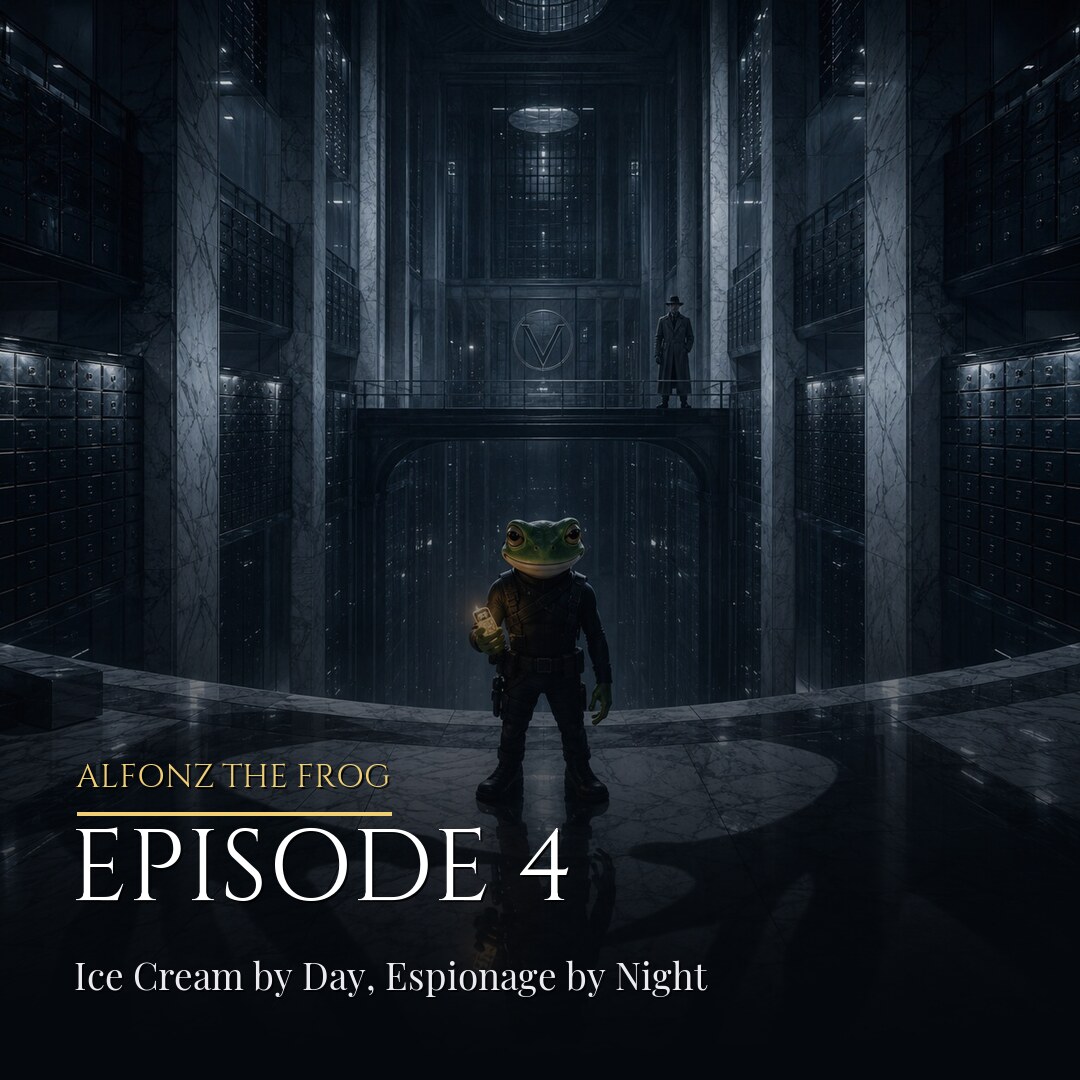
#4 · The Invisible Hand
August 6, 2026
Ruth Ellory had been a forensic accountant for thirty-one years, and she had found the thing you are never supposed to find.
It was not a weapon. It was not a plan. It was a pattern—a shape she'd assembled out of eleven years of shipping records and shell companies and commodity futures, a shape that had no name on any chart because the people who drew it had been very careful never to draw it. She had printed none of it. She had emailed none of it. She sat in her small apartment at 2 a.m. with the whole terrible shape held only in her head, and she reached for her phone to call the one analyst at the one agency she thought might believe her, and the line was already dead.
The man in the gray coat was sitting in her reading chair. She had not heard him come in. People never did.
"Mrs. Ellory," he said, in a voice like a drawer sliding shut. "You've done extraordinary work. Truly. It's a shame it can't be filed."
"You can't kill an idea," she told him, because she was brave, and because it was the sort of thing you say.
"No," the Cleaner agreed, almost kindly. "But an idea has to live somewhere. And you are the only where." He rose. "It isn't personal, you understand. It's only that you've become expensive."
By morning there was no Ruth Ellory, and no shape, and the market went on being invisible, the way it liked.
"Her name was Ruth Ellory," said Handler, "and she was mine."
Alfonz sat in the dark of the parked truck, apron off, vest on, and listened to a thing he had never once heard in eleven years: Handler, unsteady.
"She wasn't a field asset. She was an accountant. She came to me six weeks ago with a theory and I told her to keep digging, keep it in her head, tell no one." A pause with a floor missing from it. "Last night someone told me she'd died of a heart attack. Ruth Ellory ran marathons, Ribbit-7. She did not have a heart attack. She had a visitor in a gray coat."
"The Cleaner." Alfonz felt the old cold rise. "Then it's connected to Nightshade."
"It's all connected to Nightshade. That's what she found. That's the thing I've been promising to tell you since the summer, and kept not telling you, because once I say it out loud I can't take it back and neither can you." He heard her breathe. "I'm not saying it over a radio. Not after Ruth. There's a person who can tell you the rest better than I can, and against every instinct I own, she's already on her way to you."
"Who?"
"You're not going to like it."
The knock came on the back door of the ice cream truck—three taps, unhurried, a knock that knew exactly how much time it had. Alfonz opened it with his pistol already in his hand, and Scorpia looked at the barrel, and then at him, and smiled with none of the old wattage.
"Hello, Alfonz," she said. "You're going to want to put that away. We have a great deal to talk about, and not much of me left to shoot."
She had lost weight, and something else besides—the swagger, the theatrical cruelty, the sense that the world was a stage she'd been given the good part in. Budapest had taken all of it. What sat across the fold-down table from him now was leaner and quieter and, he understood within about a minute, far more dangerous than the woman who'd flooded a bathhouse to watch him slow.
"They've been hunting me since I let you live at the fair," she said, turning a cup of his terrible truck coffee in her hands, not drinking it. "Do you know what it is to be hunted by your own market? There's no rage in it. No wanted posters. They simply raise the price on your head a little every week, and wait for economics to do the rest. I have been outrunning a number, Alfonz, for months."
"You keep saying market."
"Because that is what you have been fighting." She set the cup down. "You want to know what Nightshade is. I'll tell you, because Handler's people can only see it from the outside, and I saw it from inside, and because—" a thin smile "—it happens to suit me for you to know. Nightshade is not a cause. It is not a man in a volcano who hates the world. Nightshade is the invisible hand."
"That's economics."
"That's the economics. The oldest one." She leaned in. "When a famine is coming, someone gets rich on the grain. When a war is coming, someone gets rich on the guns. Somebody, somewhere, is always long on catastrophe. Nightshade is simply the ones who stopped waiting for catastrophe to arrive—and started manufacturing it, wholesale, and cornering the market before the rest of the world even smells smoke." She spread her hands. "They don't want to burn the world, Alfonz. A burned world is a bad quarter. They want to own the fear of it. Forever. At a markup."
Alfonz was very still.
"The coffee," he said.
"Now you're getting it."
Five years ago he had chased a plot to poison the world's coffee supply, and he had stopped it, cold, three days from the first shipment—and he had spent five years believing he'd stopped a cruelty. He looked at it again now through her cold arithmetic and felt the ground tilt.
"It was never about poisoning coffee," he said slowly. "It was about the price of coffee."
"It was a demonstration." Scorpia almost sounded proud of them, which was its own kind of obscene. "Engineer a global panic, watch a commodity's price convulse, and prove to every quiet buyer in the world that you can move the fear of anything—wheat, water, medicine, uranium—at will. You didn't foil a poisoning. You interrupted a sales pitch." She tilted her head. "You've been very bad for business, over the years. Which brings me to the part you'll enjoy least."
"Tell me."
"They never sent anyone to kill you." She watched it land. "Not once. Five years. You assumed you were their great enemy, their nemesis, the frog who kept ruining everything—and all that time, up in the accounts, you were a line item. Shrinkage. Breakage. The cost of doing business in a wet world. Killing a known agency asset draws heat, and heat is expensive, and you simply were never—" she chose the word like a blade "—worth it."
It should not have hurt. It hurt tremendously. Eleven years, and the deepest wound anyone had ever dealt him was an accountant's shrug.
"So why are you here, Scorpia?"
"Because I'm a line item now too," she said. "And I intend to become expensive."
The lever, she told him, was the ledger.
A market runs on its books. Nightshade's books—who owed, who bought, who had shorted the future of a country and collected—existed in exactly one place they could never fully digitize and never destroy, because the whole point of an invisible hand is that its partners can audit it: a set of physical cipher-drives held in a free-port vault called the Argentum, in a glass city built on quiet money, where objects go to be owned by no one and taxed by nobody and seen by no camera.
"A fragment of that ledger," Scorpia said, "is proof. Real proof, the kind Ruth Ellory died for want of. Handler's Agency has wanted it for a decade and never gotten within a kilometer of it."
"And you can."
"We can. I have the inside of the place; you have the—" she gestured at all of him, the green, the tongue, the legs—"the outside of the laws of physics. Handler brokers it. You get your proof. I get my life back." She put out a hand. "One job. No trust required. Just arithmetic, the same as everything else."
He did not shake it. But he did, at dawn, get on the plane.
The Argentum was a cathedral of cold—white marble and colder glass, forty meters of vault beneath a city that never asked where anything came from. Where Sirocco's palace had been a furnace and Budapest a knife, this place was simply nothing, climate-controlled to a dead and even chill, and Alfonz felt the old sluggishness reach for him and drank half a thermos to keep it off.
They went in the way water goes in: through the one seam nobody armors, the recirculation of the vault's own climate plant. Scorpia knew the codes; Alfonz knew the ducts, the drops, the twenty-foot ascent up a dead elevator shaft that no human hip could have managed. She was good—better than good, silent and economical, and there was a stretch of ninety seconds, the two of them moving through a laser lattice in perfect wordless sequence, where he forgot entirely that she had once tried to freeze him to death.
The ledger drives were exactly where her inside said they'd be, in a drawer that did not officially exist, and they were beautiful and small and cold, and Alfonz's tongue took the fragment she pointed to and dropped it into the insulated sleeve at his hip, and that was the moment the temperature of the whole night changed.
"Ribbit-7." Handler, tight. "Movement. You have company on the vault floor, and it is not security."
"Twice now," said a voice like a closing drawer, from the dark of the marble.
The Cleaner did not hurry, because the Cleaner never hurried; he came through the Argentum's cold like a man walking to a meeting he'd scheduled, and what followed was the fastest ninety seconds of Alfonz's month—leaps that cracked the frosted glass, a tongue that took a pistol out of a gloved hand, Scorpia at his back moving like his own shadow, the two of them turning a killing box into a scattering of shattered display cases and a stunned, unconscious escort. They came up hard against the emergency stair with the Cleaner three flights below and closing, and Alfonz turned to tell Scorpia the plan.
Scorpia was pointing her pistol at him.
"I'm sorry," she said, and did not sound it, and held out her free hand. "The fragment."
"Scorpia."
"You have the truth. I told you the whole truth—every word of it was real, that was the elegant part, I never had to lie to you once." The old wattage flickered back for just a moment, and it was terrible. "But the proof isn't going to some evidence locker to make you feel righteous. The proof is going to buy me out of the number. A market respects only one thing, Alfonz, and it isn't justice. It's leverage." She wiggled the fingers. "I own a piece of their book now. That makes me un-killable. That makes me, at long last, expensive."
He could have fought her for it. In another second he would have. But the Cleaner came through the stairwell door behind her, and there was exactly one move on the board that got the truth out of that building, and both of them saw it at the same time, and Scorpia—being, whatever else she was, a professional—took it.
She shoved the fragment into his hand.
"Run, frog," she said. "You're better at doors than I am." And she turned, and put two rounds into the ceiling above the Cleaner to buy the seconds, and was gone into the cold marble the way she was always, in the end, gone—leaving Alfonz holding the one thing she'd crossed a continent to steal, and no idea, none at all, why.
He understood it on the plane, and it was worse than a betrayal, because it was cleverer than one.
"She never wanted the fragment," he told Handler, watching the dark ocean scroll by. "She wanted me to carry it out. If Nightshade's proof surfaces through the Agency—through me—then Nightshade knows the leak is me, not her. She didn't steal their book. She used me to file it under someone else's name." A breath. "She's not buying her way out with the ledger. She's buying her way out by handing them a bigger problem to chase. Me."
"So the proof is real," Handler said carefully.
"The proof is real. She played straight and crooked in the same motion. Everything she told me was true, including the part where it was all for her." He almost admired it. He was too tired to admire it. "We have what Ruth Ellory died for. And I have a target painted on me the size of the world, because for the first time in five years I am not a line item. I know what they are now. That makes me expensive."
The silence on the line was long, and when Handler spoke again there was something in it he had not heard from her before—not the dry control, not the field-calm. Something closer to grief, and closer to resolve.
"Then we did it," she said. "God help us. We found the shape of it." A pause. "I've spent eleven years handing you missions, Ribbit-7. Little ones. Weapons and microfilm and warehouses. I don't have a mission for this. Nobody does. You don't raid a market. You don't shoot an economy in the head."
"No," Alfonz said, and watched the coast come up gold on the horizon, home. "But a market can be seen. And I think they have spent a very great deal of money making sure no one ever gets to see it." He closed his hand around the cold little drive. "Ruth Ellory saw it. She just didn't have the outside of the laws of physics."
"And now?"
"And now they've been audited," said Alfonz, "by a frog."
At ten the next morning he was parked outside Riverside Elementary, and the sun was ordinary and gold, and the children came running, and Alfonz found that his hands, closing around the scoop, were not entirely steady, and made them be.
"Mr. Alfonz!" Emma was first, up on her toes. "You've got a new sad face today. Did the ledgers get you again?"
He looked down at her—eight years old, mint chip, the whole uncomplicated miracle of her—and for one vertiginous second he saw the thing Scorpia had shown him laid over the top of the world: the invisible hand, everywhere, patient, running its cold arithmetic under the grass and the balloons and the tinny "Entertainer," a market that would price this child's every fear at a markup if it could ever be bothered to notice her.
He would spend the rest of his life making sure it was never bothered to notice her.
"The ledgers always get me, chérie," he said, and handed down the cone, two scoops, the second one wobbling just so. "It is the curse of small business. But you know what I have learned?"
"What?"
"Some accounts," said Alfonz, "are worth keeping open."
Emma had no idea what he meant, which was exactly right, and she giggled and took her cone and ran off across the grass into the sunlight, and somewhere out past the edge of all that ordinary warmth a market had just noticed a frog, and priced him, at last, at everything he was worth.
He tied his bow tie a little straighter, and cranked the jingle, and got back to work.
Both jobs. Same as ever.
But he knew the shape of the enemy now. And a thing you can see, he thought, is a thing you can one day beat—one scoop, one truth, one audited account at a time.
« All episodes